

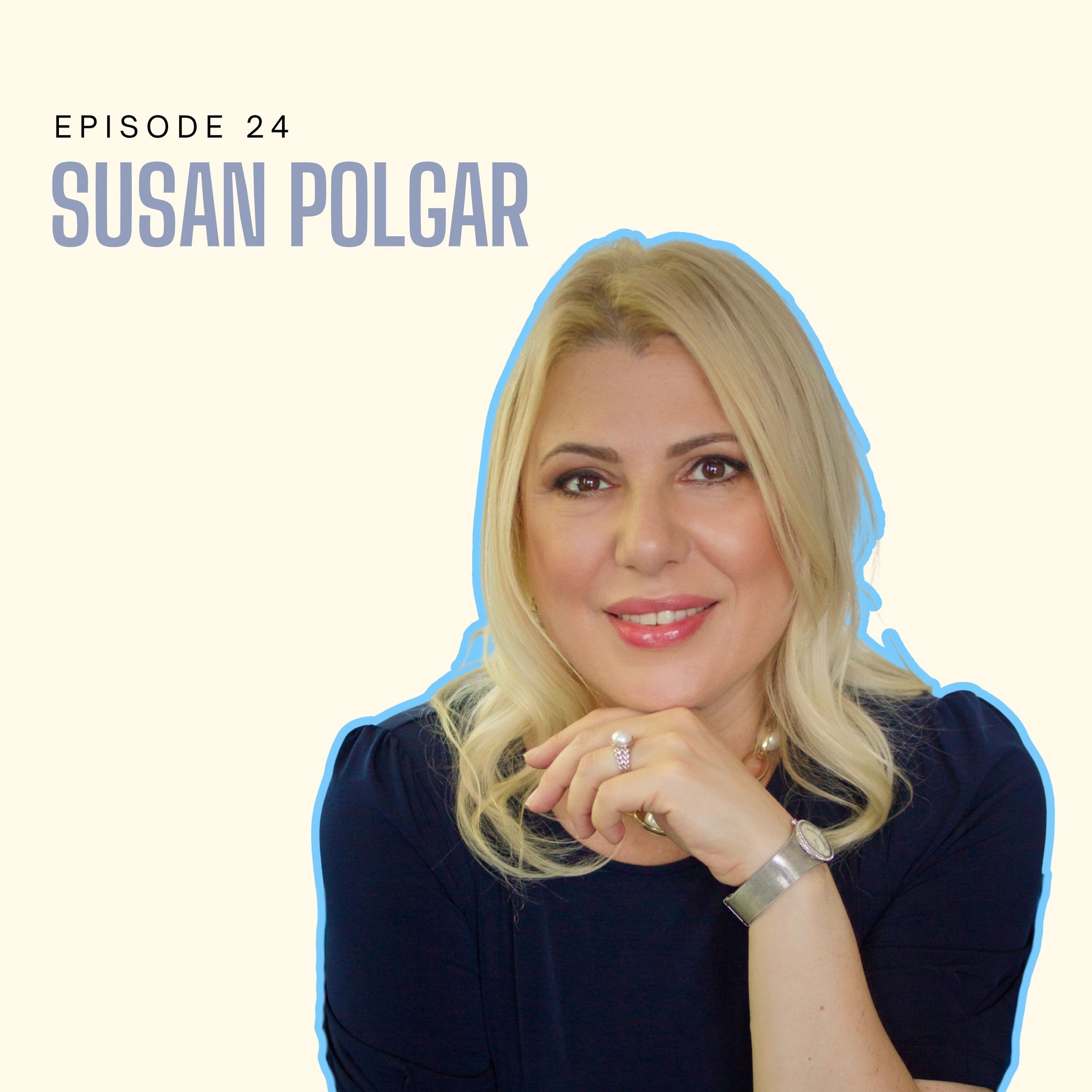
Susan Polgar’s father believed geniuses weren’t born, they were made. So when his three-year-old daughter found an old chess set in their Budapest apartment, he saw an opportunity to prove it. Susan quickly learned the game, but soon realized the real challenge: convincing the world that girls could play just as well as boys - which she did by becoming the first woman to earn the Grandmaster title under the same standards as men. In this episode, she shares how she rewrote the gender norms of chess, overcame deeply rooted sexism, and helped redefine what young girls believe they can achieve.
Hear Susan talk about:
How, at six, she decided to specialize in chess (and not math)
The sexism she faced as a young girl rising in a male-dominated field
Why her grandmother's words shaped her sense of perseverance
What came after winning world championships
The lessons chess teaches about focus, decision-making, and resilience
Mentioned in this episode:
Rebel Queen: The Cold War, Misogyny, and the Making of a Grandmaster by Susan Polgar
The Susan Polgar Foundation - scholarships, training, and outreach for young chess players
Introduction: Learn Chess in 30 Minutes (first instructional video for beginners)
“You need to set a goal. And in this case, you need to set the highest goal possible. So even if we fall short somewhat, we still get further than if we set a lower goal.”
Episode 24 Notes
Stacy Raine: This is Tell Me What It’s Like, a show about extraordinary challenges, life-changing decisions, and defining moments. I’m Stacy Raine.
For Susan Polgar, her love of chess started in childhood with a curiosity over a chess set and parents who believed that practice could create genius for boys and for girls, for all kids. Growing up in Hungary, she dedicated herself entirely to chess, despite the naysayers, and went on to change the game, not just for herself, but for all the women who came after her.
Susan, welcome to the show.
Susan Polgar: Thank you so much. Pleasure to join you.
Stacy: I’m so glad that you’ve joined me. I’m very excited for this conversation.
Discovering The Chess Board
Stacy: You had a fascinating upbringing because your dad had this theory that geniuses were made and not born. He had planned to find something that would capture your interest and focus you on that, but instead you found the game of chess and he decided he would teach you the game. So your first experience with chess was with your dad.
Susan: Actually, my very first experience was that I accidentally found the chess board and the chess pieces, and my dad was not home.
My mom rushed over when the chess board fell out of the cupboard to see what was going on. She said, “Oh, these are the chess pieces.” I had to wait until my dad came home because he was the only one in the house who at least knew the basics of chess. He hadn’t played for a long time since his high school days, but he was glad that I discovered the chess pieces that were hiding for years.
He was happy to introduce me to the game. He realized maybe we had found the subject of how he could try to prove his theories.
Teaching Chess One Piece At A Time
Stacy: At first you just thought the pieces were neat and you wanted to play with them, but he started to teach you the game. I thought the way that he taught you was really interesting. He did it one piece at a time.
Susan: I think it’s very logical actually. It’s just like the way you would teach a child to read. You don’t give them Shakespeare right away. You start with the letters one by one, then little words like cat or dog, then sentences, then small books with a lot of pictures. Eventually, years later down the line, you may read Shakespeare.
It’s the same with chess. I think It’s really important to break things down to simple, comprehensible parts before you try to put them all together and make it feel overwhelming or impossible.
Her Father’s Strategy: Always Leave Her Wanting to Learn More
Stacy: In your new book Rebel Queen, you talk about this process of teaching you. You said he would leave you hanging almost a little bit so you couldn’t wait until the next day.
Susan: Certainly.
My dad has been a phenomenal teacher. He’s a teacher psychologist by profession. He found that it was important to learn little by little and base new knowledge on an already solid foundation. You don’t build a house from the third floor or the fifth floor. The foundation is crucial and he understood that.
I think that was one of the key secrets to the success I showed early on.
Choosing Chess at Six Years Old
Stacy: At six he said, “We have to make a decision,” because you also had an aptitude for math. You made the decision at six years old that chess was it for you.
That’s a big decision for a six-year-old. How does a six-year-old decide that?
Susan: He introduced me to basic math even before chess.
My dad thought math was the foundation of most sciences and a necessary skill to have.
And I think initially he was studying a lot of famous scientists. One of the examples was Madame Curie, the famous Nobel Prize–winning scientist. He was studying very successful people — scientists, musicians, and so on — looking at what it took for them to get to where they got, to be high achievers or geniuses, whatever name you want to call it.
So math was very much part of my education from early on, and I was getting very good at it for my age.
By age six, I had a clear comparison of what it was like — both for math and for chess — because I had already been involved with both for a couple of years. I was quite good at both for my age, and I clearly understood that chess was a whole lot more fun for me.
And therefore, the choice was a no-brainer.
“But Wait, You’re a Girl”
Stacy: And then you went on, and you were looking for tournaments. You were trying to build your skills. You had various coaches.
You were getting a lot of attention, but some of it was not positive because people were saying, “But wait, you’re a girl.” That really surprised me. I don’t know a lot about chess, and I had no idea people would hold those ideas that girls couldn’t be as good.
Susan: Remember we are talking about over half a century ago. We are talking about the early, mid-1970s.
Obviously I wasn't living in the US yet at the time. I was back in Budapest, Hungary during the Cold War times. Clearly it was a man's world, even a lot more so than the world is today. It was just a given that women don't have the same abilities, the same opportunities, that they are not being treated equally.
So when I started playing chess in those days, unfortunately even the very top women players in the world were basically not anywhere in the range of the top male players. There was maybe one lady who was kind of good, but still far from the very best men players. And then everybody else were literally light years away — not even from the best, but from the second level male players or even third level male players.
So it was a huge gap. And basically they were simply pointing at the rankings, the reality that, well, look, if women could be as good as men, they would be. Just because up to that point there were no women who were grandmasters or in similar levels as men, they assumed that it's impossible. So some were chauvinistic or didn't like me, but there were also many that simply genuinely didn't believe that a woman's brain is capable of equal heights as men, and in chess specifically as well.
It was really believed so, not just in Hungary, I have to tell you, but also in other countries — maybe in some places to a lesser degree, but nevertheless. Because they saw no precedent of a woman performing, being even in the top hundred or top thousand or ten thousand in the world, they said, well, obviously it's not possible.
And the sad part was that most women believed that as well. It wasn't just the men. The women believed it too.
Proving Her Critics Wrong
Stacy: But you didn’t believe it.
Susan: And that's why we were kind of ahead of our time. My parents and I were pioneers in disbelief, and I became basically the pioneer of proving them wrong — proving those perceptions wrong, those prejudices wrong — that women are not as capable as men. I slowly but surely set it as my mission to prove that yes, women can become grandmasters just as men do.
I’m proud to say that in January 1991 I was the first woman to accomplish this feat and break the glass ceiling that was there up to that point. I’m also proud to say that based on my example, many were encouraged and empowered that, well, if Susan can do it, we may be able to as well. And today there are over 3,000 women who have accomplished this feat.
Representing An Entire Gender
Stacy: That’s amazing. Congratulations. And at the time there was a women’s grandmaster title and the men’s, and you set your sights on competing with men and gaining that title. That was very important to you.
Susan: Yes, because I felt it’s not just about me. I am representing my entire gender, and I really wanted to show them, just as much as I wanted to show the world and the men, that don’t settle for less just because you’re being told so.
And that’s really what my book is all about — to motivate, to encourage, to inspire girls who come behind me. Not just in chess, really in any field, especially in fields where women are in minority and we are constantly being told that you’re not as good. I have lots of friends in other male-dominated fields, let it be computer science or other sciences, where women face similar issues. When they get out of college with the same degree and similar skills as their male counterparts, they are expected to bring the coffee instead of do the quality work that they would expect from the guy.
Her Grandmother’s Words
Stacy: And this book really is a testament to seeing the possibilities, even when no one else has gone before you, so that you can push forward and test limits and set new records as you did.
Susan: Exactly. That’s my hope — that the book will motivate some girls, not just girls but especially girls, in the U.S. and around the world, that find your passion, work hard, and nothing is impossible.
Stacy: Do you feel like that philosophy came from your parents?
Susan: I think so, yes. Definitely. My father had his theory that every healthy-born child is a potential genius. I’m sure that’s what it stems from.
Stacy: I was thinking about this because as a kid I did not have that level of dedication to one thing. You really spent hours and hours a day. This was the thing you did. You loved it. You pushed forward and created new paths.
Susan: I came to understand early on that it may be better to get really, really good in one thing than becoming mediocre in many things. That was part of my father’s theory — that in order to prove his theory you need to start early, specialize early, and practice a lot in one particular field.
Stacy: Your grandmother had an important influence on you, especially when things got hard.
Susan: All my grandparents were Holocaust survivors.
But my maternal grandmother specifically, whom I quote in the book, would remind me in those really tough moments, when I was even considering giving up:“My daughter, you have no idea what tough is,” clearly referring to her horrendous days in Auschwitz that she luckily survived.
Putting things in perspective was really important — by her and by my parents. Yes, life is not always a walk in the park. We all face difficult moments. But compared to what my grandparents had to endure, my circumstances were nothing. I learned to have faith that at the end of the day, hard work will prevail and I will reap the fruits one day. You just have to be patient.
Winning and The Naysayers
Stacy: Do you think victory was sweeter because of all the things you had to endure to get there because people told you that you couldn't?
Susan: For sure.
Sometimes I semi-jokingly say I’m also thankful not just to my supporters, but also the naysayers. They helped me stay motivated to prove them wrong.
Stacy: That was actually a question of mine: What would you like to say to all the people who said nasty things about your family and how your parents were raising you?They didn't want you to be homeschooled. They wanted you to go to a regular school and your parents had to fight that. They said nasty things.
Susan: They did.
I’m very thankful to both my parents, especially my mom. She has many qualities, but one in particular I want to point out. She has this philosophy which is to always see the glass half full and find the silver lining. Find the good in the bad. That’s really helpful in life — not to feel sorry for myself like a lot of people do. Not to blame others, not to look for excuses, but to accept that life is imperfect and there will be roadblocks thrown your way. It’s a challenge to overcome.
That attitude became very helpful and necessary for my success.
Becoming a Grandmaster
Stacy: I felt like there were a lot of good parenting tips throughout this. Your parents seem to be extraordinary people. That's for sure. And they are. So you ultimately became the best chess player, one of the best chess players in the world at 21. You won that Grand Master's title. That's really young.
Susan: In those days that was considered pretty young. I was very proud of that. I won four World Championship titles, five Olympic Gold medals.
At one point I decided it’s great to win titles and medals, but I wanted to give back to my sport. I opened my chess center in New York and later my foundation, which continues reaching thousands of youngsters, mostly in the United States.
We have awarded over $10 million through my foundation and institute, thanks to university partners and sponsors and donors. That enabled hundreds of youngsters, about half of them girls, to get scholarships toward higher education.
I continue working toward giving opportunities to the current and future generations and raising the respect and visibility for chess in mainstream media and the world in general.
A Vision for Chess Without Gender Divisions
Stacy: You declined the women’s championship at one point and competed with men. One thing that I know you've said that was really interesting is, at one point you had declined to do, I think the women's Chess championship. And you said, well, I'm going to do the men's.
And it wasn't because you don't think they're valuable because you said they're very valuable in terms of giving women a safe place to play a game that's really male dominated, but that you envision a world where that's at some point not even necessary anymore.
Susan: That's my hope. Yes, that hopefully still in the next decade or two there won't be a need for separation. I actually qualified for the men's world championship cycle back in 1986. When I did that for the first time, I was not allowed to compete due to my gender.
And I'm proud to say that due to that incident, eventually the World Chess Federation removed the name "men's" from the championship, so today it's just called the Chess World Championship. I got opportunities, as well as my younger sister later on, to compete there.
I'm hoping that more women will start playing chess and more women will have higher goals. Because one of the problems that we face in the chess community, even to this day, is that even the top and most motivated female players generally don't aim to be the best they can be. They aim to be the best woman player.
No boy would consider, obviously, to shoot only for a lower goal. Any serious young boy would aim to be the best. Period.
And one of the main reasons why we still haven't yet had a woman who became the overall world champion is because the women don't even aim there. So me and later my sister Judit, we were the exceptions to that rule.
And I'm hoping, in order to achieve that, to have more top 10 women players in the chess world, the first step is they really need to aim to get there. It's just like, imagine you sit in a car and you just drive around aimlessly. You don't know where you're going. You need to set a goal. And in this case, you need to set the highest goal possible. So even if we fall short somewhat, we still get further than if we set a lower goal.
Stacy: I want to go back to the moment where you became a grandmaster. You had set your sights on this goal. No one else had ever reached it. I would love to just hear what that moment was like for you.
Susan: Oh, the first moments were indescribable. It was a physical sensation. It was just so fulfilling and amazing. So many years of practice and listening to naysayers and disbelievers that it's impossible. It was like I'm on the moon. It was amazing. Then eventually, of course, it set in, and then what’s next.
How She’s Giving Back to the Chess World
Stacy: And what was next was coaching.
Susan: Well, years later. Next I decided that there was another element. A lot of people believed that because I was playing, competing mostly against men, they didn’t believe that I can beat the women, that I'm afraid of the women. So that was the next immediate goal. I wanted to prove that chess is chess. It doesn’t matter if I play a man or a woman across the board. I have the same skills. And then I managed to prove that. So I won the women’s world championship in all formats.
Susan: In the classical slow time controls, the blitz, which is real fast, and then the mid range. It’s kind of like running the marathon, the hundred meter dash, and the 5K. I managed to accomplish that.
And then later on came the stage when I decided to open my chess school. I opened my chess institute, my foundation, and focused more of my time and energies in giving back, in teaching, in writing. I wrote a good number of instructional books prior to my latest book, Rebel Queen, which we are talking about, my memoirs. I have over a dozen different instructional DVDs, and I’ve been doing commentary. I was kind of becoming the ambassador of the game as well to promote the game in the mainstream.
Stacy: You really didn’t rest once you became grandmaster.
Susan: No, I slowly but surely redefined my goals. Eventually I got married and started a family, so that was easier to combine with not traveling as much as I did before to compete in tournaments.
What Chess Teaches Beyond The Game
Stacy: Your dad had this theory that geniuses are made and not born, and if you learn something very specific that will help you all through life. You’ve won every chess title imaginable, and you’ve helped all these kids. How did learning the game of chess help you outside of the game of chess?
Susan: I think that's the beautiful thing about chess, really. Chess actually is an amazing tool to learn many different life skills for children.
That's why I am such a big advocate for chess, especially in schools, regardless if somebody wants to become a competitive player or a professional player. Just to give you a few examples on how chess helped me or can help anyone: chess teaches you to concentrate, to focus, to analyze, to make decisions.
Susan: To consider the other side's position or thoughts or goals. To be patient, to be creative. To think in short- and long-term goals. And this is just to mention a few of the very important life skills that we practice naturally when we play a game of chess or study chess.
Stacy: And all in a game.
Susan: Which is pretty fascinating. Exactly. And that's very important because kids have kind of a resistance to learning, a lot more so than when it's playing or learning via playing.
Stacy: Right. You had this example with some of your coaches. You’ve talked about in your book that you had coaches that would make you laugh.
These coaches would come over to your house and work with you once a week, and some of them were really funny and would make you laugh, and you had a lot of fun with them. And then you said you had one who was kind of a renowned, very famous chess player, and you said he was very strict and took all the fun out of it, and you didn’t really want to play with him.
So I thought that was an interesting lesson on teaching kids and parenting and things like that. Did you find that the way you related to your various coaches influenced the way that you in turn coached?
Susan: Yes, I think naturally I observed their teaching methods as a student. Somehow quite early on I dreamt that I'd like to have my own students, my own chess school. And I guess subconsciously I was already picking those tips up as well. Of course, I got to practice pretty early on when my sisters, who are significantly younger than I am, showed interest in chess as well. And they were my first students.
From “Black Sheep” to “Golden Girls”
Stacy: Ah, that's adorable. And they too are very accomplished.
Susan: Yes, indeed. Eventually the time came when they got a bit older — not very old, 12 and 14 — when we got to represent our native country, Hungary. Along with another girl, the four of us made Hungary proud by defeating the great Soviet Union and everybody else and winning the Olympic gold in 1988.
Stacy: What was that moment like?
Susan: Oh, that was just one of the most amazing moments in our lives. It was absolutely life-changing because up to that point, back in Hungary, we did not have the support of the chess authorities of the Hungarian Chess Federation. Then when we brought the gold home for the nation, all of a sudden, from the black sheep, we became the golden girls from one minute to another.
Stacy: You could just see that transition so easily.
Susan: Yes. Overnight, literally.
Stacy: Wow, that's fascinating. You’ve said that with chess, you could go to the chess board and focus and block all of that out. I thought that was really interesting. Why do you think you could do that? Where did that ability come from?
Susan: Chess requires very deep concentration. In an ideal situation, you're supposed to be able to exclude pretty much everything that's ongoing around you, even within the same room.
You need to get so deep into your thoughts that the world doesn’t exist around you. That’s a special skill that we naturally train all the time because there is no room for error. It’s a very demanding mind game that chess players, if they want to succeed, need to get better and better at.
Stacy: When I was reading your book and you were talking about how young you were — you were not even four — I have a not even four-year-old, and I looked at him and thought, I don’t know that you could do this. But now I’m thinking maybe he and I can learn together. It would be great to teach him these life skills.
Susan: I think so. I think it’s a great game to learn as a hobby, as a skill builder, even if somebody’s not aiming to be a world champion in chess. I actually have a very good instructional video called Learn Chess in 30 Minutes.
Stacy: Okay.
Susan: It’s literally 30 minutes. It’s animated, so it’s a lot of fun for kids. When my kids were around four, five, six years old, it was their favorite nighttime story because of the animated characters.The video has two 30-minute segments. The first introduces simply the rules of the game. Then there is another 30 minutes introducing basic tactics and strategies. It’s aimed for young audiences or beginners in general, but it’s a fun, enjoyable video with some jokes involved.
Stacy: That sounds great.
One of my questions is what would you suggest for kids who are still new to the game, but also for adults like me who find it a little bit intimidating, but think it would be fun to learn.
Is that a good video for someone like me?
Susan: Absolutely. It’s something you can do on your own or with your child. It’s a great bonding activity between generations. That’s one of the beauties that I liked from early on in chess — there are no boundaries. It didn’t matter that I was a tiny girl and would play with my dad or with people my grandparents’ age. There are no boundaries between genders or age or strength. It’s something you can play all your life, at home, indoor, outdoor, regardless of the weather, regardless of socioeconomic situation. It’s really an equalizer.
We were a poor family during Cold War Eastern Europe times, and chess overcame all those differences. It’s something we could equally enjoy with people in America or anywhere in the world.
Chess is The Fairest Game
Stacy: You’ve called it the fairest game, and I love that term. What’s one thing you want people to know about the game of chess or your journey? Or what you feel like they could learn?
Susan: I think chess is an amazing game. It teaches you a lot. It’s an amazing hobby.
As I was traveling around the world — over a hundred countries so far — in most places you find chess players and immediately have something in common and make new friends.
Stacy: Wonderful. Well, Susan, thank you so much for joining me on this show and telling me what it was like to have this wonderful career in chess.
Susan: Thank you. It’s my pleasure to be here with you, and I hope everybody else enjoyed the conversation.
Continue the Conversation
Listen & Follow Tell Me What It’s Like
Follow the show so you don’t miss future conversations about uncommon experiences and the perspectives they’ve shaped.
Know someone who would enjoy this story?